Baba X
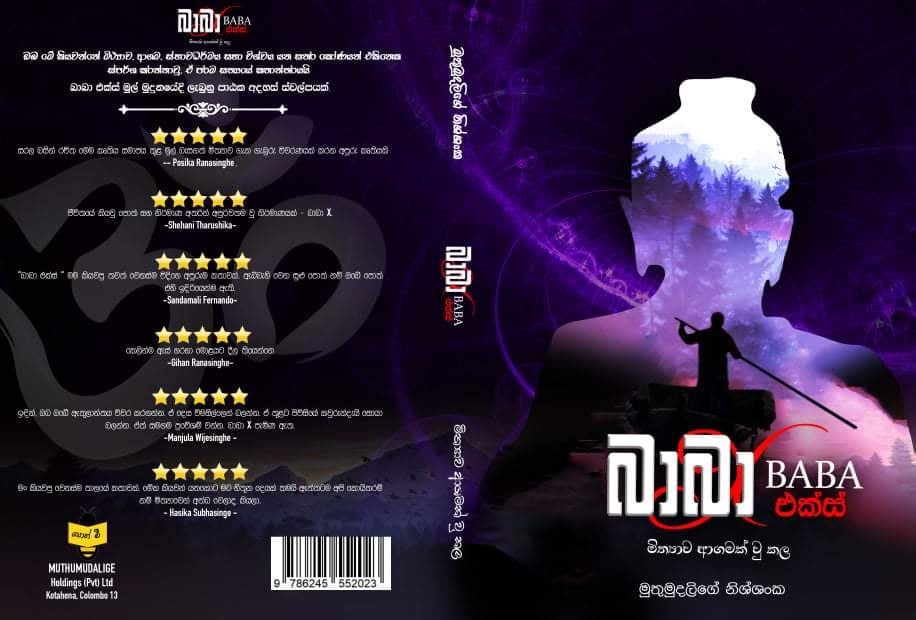
“Religious myth” — a virus. A dangerous, mind-infecting virus. And as I write this, it’s still spreading like wildfire across Sri Lanka.
Among contemporary Sri Lankan writers, if there’s one who has stirred the most controversy, it’s me.
But I don’t fear controversy. I don’t write within lines drawn by others. When someone draws a circle around me and commands me to stay inside, my instinct is to step outside it — to explore, to question, to feel. I’m drawn to the emotions people suppress, the truths they’re ashamed to speak because of culture, religion, or tradition. I love peeling away the masks that people wear and exposing their true selves to the world.
That’s what I do with my writing. That’s what I do with my art.
If Sri Lanka becomes a place where I cannot create freely, I will go elsewhere. Because true artists cannot — and should not — be trapped inside a cage of silence. An artist who stays within borders drawn by fear is not an artist at all.
My tenth book, Baba X, was born from a deep frustration. Its core message is built around the same dangerous virus I mentioned earlier: the “religious myth” still strangling the minds of many Sri Lankans today.
We speak freely about politics. We analyze the economy. But the moment the topic turns to religion, there’s a chilling silence.
Why?
Fear.
Fear that’s been embedded deep inside you — by priests, by tradition, by superstition. Fear that says, “If you speak, God will punish you.” Fear that silences even the loudest political voice when it comes to faith-based fallacies.
People fear questioning religion — not because they lack awareness, but because they’ve been taught not to. They see harmful myths destroying minds, dividing society, but still say nothing. Some even pass these myths down to their children, dragging the next generation into the same darkness.
And all of it is hidden behind a mask they call respect — blind, unquestioning, ignorant respect that demands obedience without thought.
I wrote Baba X for those who are trapped in that fear. For those who see the damage but justify it. For those who silence their own minds in the name of tradition. For those whose intellect is caged by inherited beliefs.
If Baba X inspires even one person to question the myth, to break free, to protect their children from this cycle — then that will be a real victory. Not just for me. But for the future of the country I still call home.
Throughout history, religion — or more precisely, religious myths, fanaticism, and blind belief — has not only shaped societies but destroyed them. The price paid in human lives is staggering.
Whether through holy wars, genocides, or systematic oppression justified by faith or divine command, an estimated 195 million people have died as a direct or indirect result of religious belief or religiously motivated violence.
Here are just some of the darkest stains in that history:
-
The Crusades: 6,000,000 lives lost
-
Thirty Years’ War: 11,500,000
-
French Wars of Religion: 4,000,000
-
Second Sudanese Civil War: 2,000,000
-
Lebanese Civil War: 250,000
-
Muslim Conquests of India: 80,000,000
-
Congolese Genocide under King Leopold II: 13,000,000
-
Armenian Genocide: 1,500,000
-
Rwandan Genocide: 800,000
-
Eighty Years’ War: 1,000,000
-
Nigerian Civil War: 1,000,000
-
Great Peasants’ Revolt: 250,000
-
First Sudanese Civil War: 1,000,000
-
Jewish Diaspora (excluding the Holocaust): 1,000,000
-
The Holocaust (Jewish + LGBTQ+ victims): 6,500,000
-
Islamic Terrorism since 2000: 150,000
-
Iraq War: 500,000
-
U.S. Western Expansion (“Manifest Destiny”): 20,000,000
-
Atlantic Slave Trade (justified through Christianity): 14,000,000
-
Aztec Human Sacrifice: 80,000
-
AIDS deaths in Africa (worsened by religious opposition to condoms): 30,000,000
-
Spanish Inquisition: 5,000
Total deaths in the name of religion, myth, or blind belief: ~195,035,000
Let that number sink in. Behind every digit is a life — a person, a family, a future. Lost not to natural disaster, not to accident — but to dogma, ideology, and the misuse of something meant to be sacred.
Sources: Wikipedia, Reddit, historical archives, and public data.